Starting in 1996 the Edinburgh Cohesion Tester
(ECT) was developed over several years with funding from the
British Coal Utilisation Research Association (BCURA) and UK
Department of Trade and Industry to enable rapid assessments of a
coal's handling characteristics. Several UK coal producers also
assisted with the evaluation of the ECT in the UK. ECT
Testing can be carried out in Australia through
CoalTech.
As shown by many researchers the unconfined
compression strength is a measure of the cohesive strength of a
coal and is the property of the coal that determines a coal’s
handleability characteristics. The ECT has been devised to measure
directly the cohesion developed in a coal under a known
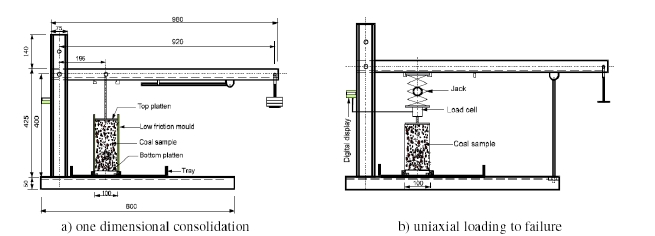
consolidation pressure (Figure 1).
|
|
|
Figure 1
Edinburgh Cohesion Tester
|
Figure 1(a) shows the removable three-piece mould
into which coal is placed when a uniaxial consolidation pressure is
applied. Figure 1(b) shows the consolidated column of coal during
loading to measure the unconfined compression strength by a load
cell. The maximum load applied by the jack is recorded by the
digital display. The ECT uses similar principles as the triaxial
and uniaxial testers developed in the early 1990's by Electric
Power Research Institute (EPRI) of the US [1]. The same
method was later adopted for the tester developed by
Newcastle University [2].
The ECT has been used by Edinburgh University to
undertake extensive studies of many coals to discover key phenomena
relating to handleability. The tester has been improved over the
years of research with several new features, which significantly
improve the test procedure and results, and substantially overcome
the main problems encountered in other similar testers. These
features include:
- a three
piece split mould used to minimise the disturbance while setting up
the sample,
- the
mould is coated to reduce wall friction during vertical
consolidation,
- support
of the mould on a spring loaded base to effectively consolidate the
coal from top and bottom simultaneously and also to minimise wall
friction effects,
- sample
height correction to avoid interference with the initial sample
(cutting or adding material after consolidation), and
- a
digital display with a peak hold to record the maximum vertical
force required to fail the sample.
A patent application for the novel features of
this tester has been filed by Edinburgh University.
Predictions obtained with the ECT were compared
with the results obtained using the Durham Cone [3,4]. Comparisons
were made both in the laboratory and in field trials. The field
evidence used was the time taken to unload a train and a detailed
pro-forma report on each trainload of any observations of coal
bridging in the receiving bunker or action required to aid
discharging (air lances etc). These tests showed that the Durham
Cone can distinguish between very good and very bad handling coals,
but was erratic when coals close to the limiting acceptable
handleability were tested, thus explaining why handleability
problems still exist despite the thirty-year extensive usage of the
Durham Cone. The ECT results at the colliery successfully
identified all 6 consignments out of a total of 50 consignments in
the trial that were later reported to be problematic at the
receiving power station. This allowed a much improved ranking of
the coals and therefore gave a better indication of the possible
handling problems of marginal coals.
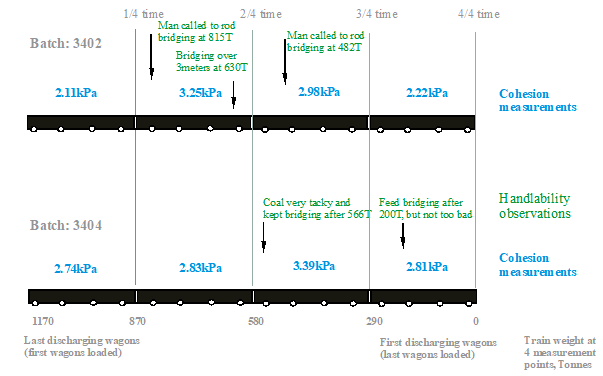
Figure 2 shows that the ECT measurements for two
problematic consignments, which indicates that handling problems in
the receiving bunkers occurred when the ECT measured unconfined
strength was around 3 kPa.
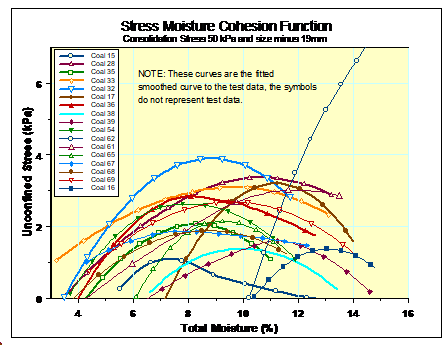
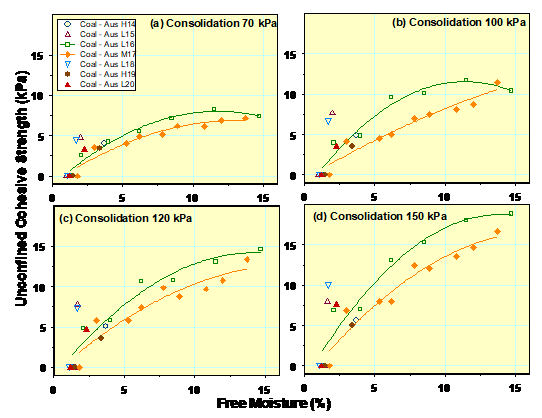
Edinburgh University found that handleability is
very sensitive to moisture content in a highly non-linear
manner. Each coal has a critical moisture content at which
its handleability reaches its worst condition. The critical
moisture content may be low, and the coal may appear relatively
dry. The handleability of a coal is characterised by its
Stress-Moisture-Cohesion (SMC) function that describes the effects
of both stress and moisture on the particular coal. This
function is obtained by progressive wetting of the dry coal.
Zhong and others [5] devised a mathematical model
to predict the resultant cohesion of a coal blend consisting of
three source materials whose SMC functions are known. The
non-linear character of the handleability of blends was
successfully taken into account by using a blending factor, which
can be found experimentally. The predicted cohesions of trial
blends were found to be in very good agreement with
experiments.
The speed of testing of the Edinburgh Cohesion
Tester permits a substantial increase in the available information
on the sensitivity of coal handleability to different key coal
quality parameters. This tester can be easily transported and used
by other laboratories. Repeatable tests can be achieved with only
15 minutes of operator training.
An agreement between The University Court of the
University of Edinburgh and CoalTech Pty Ltd allowed CoalTech to
import into Australia a manual Edinburgh Cohesion Tester.
Edinburgh University assisted with the development of the test
procedures and interpretation of the results in a recent
ACARP
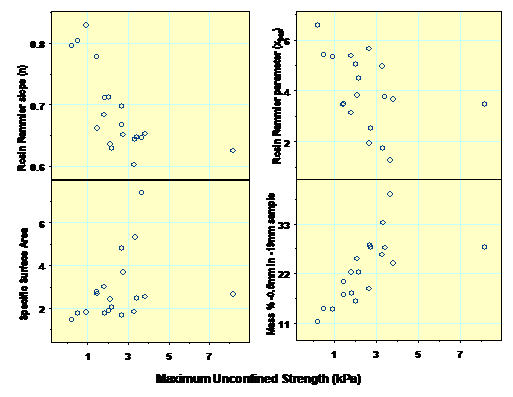
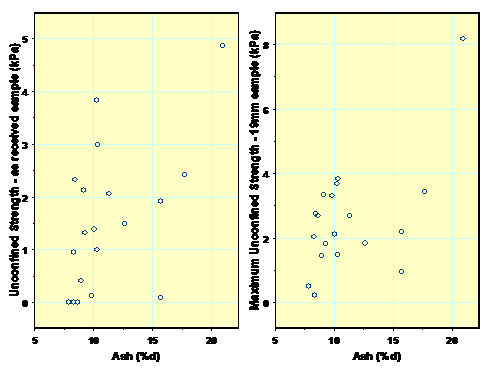
project. This project found that all coals tested
had unique SMC functions and that the size distribution (not just
the fines content) and ash content significantly influenced the
handleability of the coals. The ECT is a superior test to the
Durham Cone for investigating the causes of handleability problems
as it gives a better discrimination between coals that may or may
not have a handleability problem.[1] Arnold, B., (2004), Efficient handling of
coal for power plants: Development of a coal handleability index,
Coal Preparation, Vol 24, 2004.
[2] Chambers, J., Liu, Y., Roberts, A., (2001),
Effect of various coal constituents on the storage and
transportation of coal,
ACARP Project C6057.[3] Ooi, J.Y., Rotter, J.M., Lahlouh, E.H. and
Zhong, Z. (1998), Blind trial on coals for rapid handling
assessment, Proc., 6th Int. Conf. on Bulk Materials Storage
Handling and Transportation, I. E. Australia, September,
Wollongong, Australia.
[4] Zhong, Z., Rotter, J.M., Ooi, J.Y. and
Armstrong, B. (2001), Rapid assessment of handling
performance for coals, Proc., 18th Int. Coal Preparation
Exhibition & Conf., Kentucky, USA, May, 47-61.
[5] Zhong, Z., Ooi, J.Y., Rotter, J.M. (2005),
Predicting the handleability of a coal blend from
measurements on the source coals, Fuel, Volume 84, Issue 17,
December 2005, Pages 2267-2274