|
Home
>
Influence of Coal Properties
>
Combustion
|
 Previous
Next
Previous
Next 
|
|
|
|
|
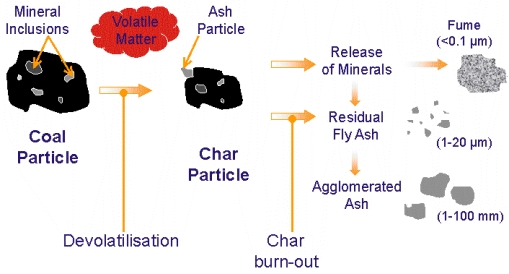
In the burner region coal particles are rapidly
heated to approximately 1300°C in about 0.1 of a second and
devolatilise
. The heat transferred to this region (derived from the hot product
gases, by radiation from the surroundings, and from the energy
generated in this early stage of combustion) plays a very important
role in stabilising the flame, especially in low NOXswirl
burners.Char
burnout takes place in the furnace chamber.
Combustion efficiency is determined by the time- temperature
history (i.e. furnace design), the char particle size, and char
reactivity. The char particle size is determined mainly by the
fineness of grind of the pulverised fuel. Char reactivity is
dependent on the rank and the maceral composition of the original
coal, but may be enhanced by some minerals. The heat content of the
volatile matter is also dependent on the rank, type and mineral
matter content of the coal.
Char burnout for blends, made from coals of
similar rank, can be estimated from the burnout characteristics of
the component coals. Burnout can be influenced by the blend
composition when
- there
is a large difference in the rank of the coals which can result in
two completing phenomena
-
Adverse Impact - the lower rank coal can react with the
available oxygen faster and therefore impede the burnout of the
higher rank coal. This tends to occur when the rank of the lower
rank coal is sub-bituminous or lower and it is the main coal in the
blend.
-
Beneficial impact - the fast release of the volatiles from
the lower rank coal provides a hotter thermal environment, without
significantly reducing the oxygen, this will aid in the combustion
of the higher rank coal. This tends to occur when the lower
rank coal is bituminous of good combustion performance blended with
a higher rank coal of poorer combustion performance or when the
lower rank coal is sub- bituminous but is a minor component in the
blend.
- there
is a large difference in the milling performance of the coals
resulting in preferential milling of the softer coal which is
normally a higher rank coal of marginal combustion
performance.
- Coal
qualities impact significantly on operating costs of coal-fired
installations. Generally coals with low total moisture, ash and
sulphur, high specific energy and good combustion performance can
minimise total plant costs. The table below summarises some of the
more significant coal properties used in the evaluation of thermal
coals.
|
Coal
Property
|
Standard
|
Influence on
combustion
|
|
Sizing
|
|
Coal having more than 30% of minus 2mm fine
particles can cause handling problems with the frequency increasing
as the fines percentage increases.
|
|
Total moisture
|
AS 1038.1
|
High moisture content increases transportation
costs per unit of energy and may increase handling problems,
depending on the clay content of the coal. High moisture
coals require increased energy for drying in the mill.
|
|
Proximate analysis
|
AS 1038.3
|
The ratio of fixed carbon to volatile matter
(fuel ratio)indicates the ease of ignition
and burnout, but
the heat content of the volatile matter is a more reliable guide to
ignition. The volatile matter content influences NOX formation.
Generally for the same burner and constant nitrogen content,
the higher the volatile matter the lower the NOX. Low values of ash
are generally sought; however, in stoker firing a minimum ash level
of 5% or more is necessary to protect the grate from
overheating. |
|
Ultimate analysis
|
AS 1038.6
Parts 1, 2, 3
|
This analysis is required for calculating
stoichiometric air requirements and the volume and composition of
the products of combustion, with the exception of NOX which also
depends on combustion conditions.
|
|
Forms of
sulphur
|
AS 1038.11
|
These figures give the distribution of the total
sulphur between organic, inorganic and sulphate. Total sulphur can
be used to estimate SOX
emissions, though some SO2 is absorbed by calcium
in the ash. |
|
Specific energy
|
AS 1038.5
|
The heat derived from the combustion of
coal is of prime importance and can be reduced by high levels of
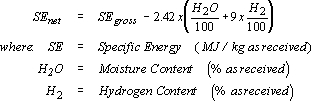
ash and moisture, or poor utilisation efficiency. The net specific
energy is obtained by subtracting the latent heat of water in the
combustion products from the gross specific energy.
|
| Ash fusion
temperatures
|
AS 1038.15
|
Low ash fusion temperatures may lead to slagging
(deposits within the furnace chamber) or to fouling (deposits
in the convective passes of a boiler). |
|
Ash analysis
|
AS 1038.14
Parts 1, 2, 3
|
The composition of the ash of a coal influences
the slagging and fouling behaviour and also the performance of the
fly ash collection plant. Use to calculate relationship between ash
analysis and fouling and
slagging indices. |
|
|
|
|
|