The coke yield and by product yield from any
cokemaking process is a function primarily of the coals from
which they are produced and the carbonising conditions. The
figure below shows that about 64% of the as received coal is used
in the blast furnace (BF).
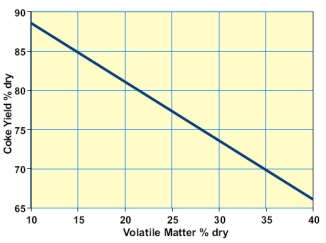
As shown by this figure below there are two
factors that influence the yield of blast furnace (BF) coke:
-
Yield of dry wharf coke, this depends mostly on the
volatile matter of the feed coal and can be estimated from -
-
Yield of lumped BF - After the wharf coke is
stabilised (usually by dropping from a fixed height) it is sized to
remove the coke breeze. The coke breeze is used mainly as a
fuel in the sinter plant. The yield of lumped BF coke after
sizing is dependent on the fission formation during the coking
process and coke morphology .
Low rank, high volatile coking coals yield
predominately a very porous highly reactive isotropic carbon with
only a small proportion of fine textured anisotropic domains. Thus,
the proportion of edge carbon remains high and hence the reactivity
is also high. The situation improves gradually as the rank
increases and in blends with prime coking coal, the hydrogen donor
capacity is high enough to effect some improvement in coke texture
relative to that expected from some lower rank components in a
blend if there were no fluid phase interactions. There are no
significant interactions between higher rank, low volatile, coals
with prime coking coals in a blend with respect to texture
development. The former contribute to wall thickness and strength,
as well as the coke yield and can also decrease the pore size if
the volatile yield is greater than about 12% and the there is
some fluidity.